Tried.

No wonder I am tried like hell when I got home today. I have a full day of work, plus 2 hours of driving and 4 hours of classes. That is almost like working a double shift. Fortunately, I only have one more class left on Friday.

At first, I just pick up firearm as a hobby. The more I read about firearm, the more I appreciate the reasons behind America’s forth amendment. In Canada, people are only allow to shoot as hobby, but firearms really should be intended for self protection and preservation of liberty. The argument is not intuitive, but elegant when lay out properly. I read two reports from the Fraser Institute, compare the crime rate in gun control countries before and after the regulation. The conclusion is gun control does not lower the crime rate. The criminals still have guns, but the victims now deprived of their means of self defense. If every people is rational and law binding citizen, then gun actually make the society safer. The only problem is there are crazy people shooting others once a while. This problem can be deal with if everyone carry a gun and learn to disarm the crazy guy at any sight of trouble.

Arguing in the scope of political philosophy, gun actually protect the liberty of the citizens. Without any means of self protect, good citizen can only rely on the police to protect themselves from criminals. In order to effectively protect defenseless citizens, the government have to increase the authority of police. Everyone knows increasing the police power will erode the liberty we enjoy in the society. Gun ownership promotes a smaller government, which is good for the economy and liberty. This pro-gun argument is still a very rough idea, I should give it more thought and write an article exploring it with further details.

Project management

There are two kinds of project, one use proper project management techniques and the other has absolutely no project management. Managers in my old department are the firm believers of the first kind. We try our best to do project planning, estimate the scope of work, resource requirement and schedule. We have objective matrix to to measure project progress and individual performance. So, the projects are running quite smoothly and in general people are compensated fairly.

On contrary, people in the new department, from top to bottom, lacks any viable project plan. No wonder the project is in a mess and people feel like being slaved. The leader and manager have no clue whether the schedule is on track, since they don’t have any estimations to begin with. There is no way to keep track of progress, they don’t even know what the scope of work should be. All they have is just a date and the mentality is to meet that date at all cost. The task assignment is vague, you have no idea what is the real amount of work you have signed up for. You don’t see the light at end of the tunnel, you don’t even know how far you are from the finishing line. To make it worse, people refuse to do proper planning, using lack of time as an excuse. Here is a catch 22 situation. If you didn’t plan ahead of time, it is guarantee you will run of of time at the end. How can you meet the schedule if you don’t even know what is the scope of your work? Then the busier you are, the more excuse to ignore planning, hence formed a downward spiral all the way to the doomed land.

When it comes to evaluation, since there is literally no data on how well you perform, it all comes to the boss’ impression of how hard you work. In project management, evaluation should be result oriented instead of effort oriented, lots of effort does not always mean good result. Result is what delivers to the custom at the end of the day, not the effort you spend in making the result. Measuring on effort will tempted people to creates artificial effort out of thin air which is not tend to any result, with sole purpose of leaving good impression to your boss. Luckily, my intermediate boss of the project is a nice guy, so its not a big issue for me. However the boss one level up lacks visibility of my work, how can he evaluate me fairly?

Responsibility and expectation of the deliverable has to be clearly define, otherwise it will only lead to the tragedy of common. Being flexible does not mean refusing to laying out any job boundary. Dynamic adjust the job boundary to cope with the need is perfectly fine, as long as at a certain moment, everyone knows who is responsible for what. Theoretically speaking, anyone can do anything given enough time. The question is whether the time is spent efficiently. For example, the verifier can dig out the required information from the design if necessary. But the time of verifier is not best use in document hunt, it takes much less time for the designer to update the document in the first place. It is the designer’s job to provide adequate document to the verifier. Busy is not an excuse for the designer not doing his job right, since verifier is equally busy.

People are willing to walk a few steps further when they are working with friends. However, friendship cannot replace the need to define job boundary. It is OK when things are working fine, but sometimes things may get edgy. In this case, the job boundary definition comes in handy, it prevents friendship turning sour from misunderstanding. Just like no matter how good the friendships you are, money matter always have to deal with absolute clarity.

If any project management courses wants counter examples on productivity. I think I have a textbook case of poor project management. Enough bragging for today.

Firearm license course

I am totally exhausted today.  After work, I drove 30 minutes into Surrey to take the Firearm license training.  It is 4 hours of lectures and practice after a long day of work.  In Canada, it is required by law to acquire the firearm license in order to own a gun.  The license exam is on safety and regulations.  It has two parts written exam and partical exam.  In the course, we are not allow to discharge any weapon, but there are lots of disactiviated real gun for us to practice proper handling.  We are taught all the new terminologies used in firearm and hunting, different parts of guns, types of guns and bullets, shooting and carrying position, etc.  Although there are tons of new materials I have to memorize, I found the lecture is very interesting, even the history of guns section.  The instructor even perform a small expreiment, show us the difference between lighting black powder and smokeless powder.  Now I know the real gun powder doesn’t look like anything they use in the movie.  Technically speaking, gun powder is not explosives but propellent, which push the bullet down the bore and shot out from the barrel.

In the pratical exam, we have to demostrate we can handle 5 types of rifle and 4 types of handguns safely by follow the ACTS and PROVE procedure.  So, after the classroom time, the instructor let us play with the guns.  We are not really playing with the guns.  We are just repeatly unloading every gun, inspect all the check points, then load it back, pretend to fire, unload the gun once again before putting it down.  Putting your finger into the trigger or pointing the gun to anyone is an instant fail in the exam.  Gun has to handle with great care.

Contrary to popular beliefs, firearm is actually very safe if you know what you are doing.  In Canada, only 1300 death from firmarm, much lower than the toll of death from automobile or cigerrates.  As a sport, shooting has a much lower death ate than swimming.  Many people’s phobia to guns are unjustified, and it mostly rooted from the myth created by all those Hollywood movies.

Coffee shop in Tibet

This world is full of interesting people.  I just know a guy from Hong Kong, Pazu, open a coffer shop in Tibet.  Well, actually I don’t exactly know him, he is the webmaster of a site I used to visit a lot back in university days.  This guy is quite legendary, after he graduated from university, he became a full time traveler for the past 7 years.  I was following his foot steps on and off from the travel journals posted in his site.  He spent 3 years backpacking the every  in China, India, Pakistan, Nepal and Afghanistan(!), visiting places I would not even visit in my dreams.  After he come back from his long journey, he begin another even crazier journey in 2004.  He spent another 3 years going back and forth between Vietnam, Laos, Thailand and Cambodia in bicycles!  Finally, his long journey comes to an end.  He decided to settle down and open a coffee shop in Tibet after biking there all the way from Thailand.  There is a saying that travel ten thousand miles is better than reading ten thousand books.  This guy traveled ten times more roads than I will ever travel in tens of my life time combined.  I can imagine talking to Pazu would be full of eye opening stories.  Too bad that I don’t have the patient to follow his trip day by day in his travel journal.  If he write a book about his years long journal, I will get one at once.  Maybe HK’s television station should interview him and produce a hour long special program.  That would be more interesting than the usual brainless entertainment shows.

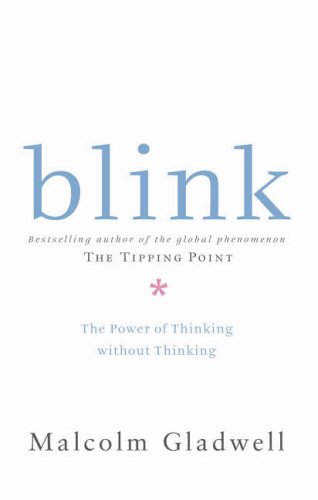
Blink – Malcolm Gladwell

Blink 若要找一個詞語來形容Malcolm Galdwell﹐我想最適合的詞語大慨是一代宗師(Guru)。他只出版過兩本薄薄的小書﹐但他為社會帶來革新性的影響﹐被時代週刊選為全球百大最有影響力人物之一。我讀完他的第一本著作Tipping Point後﹐原本認為他有點名過其實。畢竟那是幾年前的舊作﹐當年有見地的新思想﹐在今天只不過是常識﹐令我感受不到他想思的振撼力。可是當我拜讀過他網站上紐約客的文章﹐我對他刮目相看印象完全改觀。他不光靠兩本流行讀物吃老本撈名氣﹐而是一個真材實料的學者﹐為社會帶來全新思維模式的先知。這次我拿起Blink來閱讀時﹐與抱著半信半疑地閱讀Tipping Point的心態大不同﹐我懷著尊敬的心去欣賞偉大思想家的重要著作。不單吸收作者書中的思想內容﹐還學習他小故事配合科學理論的寫作風格﹐好讓我拉車邊沾點他說話的感染力。

Blink這書探討人類瞬間思考力的問題。很多時候我們會花很多時間思考一個問題﹐可是做出決定卻只是瞬間的事情。有些專家可以用瞬間思考力﹐得出來的答案比整隊人化三個月時間研究還準確。很多時候這個瞬間思考力被認為是第六感﹐擁有這個能力的人答不出憑什得出這樣的答案﹐沒有詳細的推論也沒有數據支持﹐答案好像一瞬間從腦中忽然冒出來一樣。作者引用切片理論(Thin slicing)去解釋瞬間思考力從何而來。專過長年累月經驗告訴他們﹐如可在極短時間內﹐在大量的數據中﹐找出關鍵的那一小薄片數據。這個思考過程是腦子的潛意識反應﹐像運動員不需思考﹐就可以揮拍迎擊飛來的球一樣。

當然瞬間思考也有誤導我們的時候﹐沒有受過長時間訓練的人﹐他們瞬間思考與瞎猜無異。最特別的是這個瞬間思考力﹐是會受到潛意識的影響。一些看似與要考慮的問題沒有關係的雜念﹐不單會影響瞬間思考的正確性﹐甚至會把答案引導上錯誤的方向。作者引用美軍中情局的模疑軍事演習﹐和芝加哥急症室的醫生斷症作為例子﹐指出過量的資訊有決策明顯的害處。要善用瞬間思考力﹐就需要過濾無用資訊的雜音。

要知道那些資訊有用﹐那些無用是一門大學問。作者在這章引用著名的百事口味大挑戰作為例子﹐亦解答了我這個可口可樂忠實擁躉多年的疑團。話說當年百事可樂的口味大挑戰﹐倒兩杯蒙著牌子可樂給受訪者試飲﹐大部份人也喜歡百事多於可口可樂。原本這只不過是百事的廣告策略﹐但在可口可樂私下進行的口味測試中﹐受訪者也是多數喜歡百事。於是可口可樂推出改良口味的新可樂應戰﹐新可樂的下場如何大家也記得﹐最後這一役成為商管課本中的典經失敗例子。只是百事可樂真的比可口可樂好飲嗎﹖原來答案在於試飲的設計上﹐試飲只給受訪者飲一小杯可樂﹐對於味道較甜的百事有優勢。但是現實中沒有人只喝一口汽水﹐一飲就是飲一整罐。由於百事偏甜﹐飲完整罐後的殘留在口腔感覺﹐並不如可口可樂般好飲。作者最後用警察和管弦樂團的例子﹐指出防止作出錯誤決定的最佳的辨法﹐就是防止我們置身於錯誤的資訊中。

這本二百多頁的小書﹐我只用了兩程短途機的時間就看完了。通常大部份人看書會略過注釋不理﹐不幸地我在飛行半途中剛好看完全書。反正左右也沒事幹﹐便把書後附錄的注釋也仔細閱讀。書中作者隨便引用了很多故事﹐乍聽起來那些故事像是道聽途說﹐與本書學術性的主題關係不太。可是在注釋中我發現﹐書中的每個故事也是有根有據﹐全部引用自學術期刊發表的論文或是專門的學術書藉。書中講道理看似在輕鬆地說故事﹐那其實並不是作者無料吹水﹐而是作者文筆功力深厚﹐把艱深難啃的學術知識消化﹐再化成淺白文字讓讀者容易理解﹐作者現代賢者的稱號絕對並非浪得虛名。